Tuesday, April 24, 2012

Hungry Bee


Last winter, very late in the afternoon, I encountered a lone bee on my steps. It was getting chilly, and being aware of how far away the beehives are, I figured she might have been too tired to make it home. There wasn't much blooming in the garden.


So I got this idea in my head that some honey might help her. I went inside and dipped a toothpick into a jar of (yes, organic local unfiltered) honey and set it in front of her. It worked. She drank for quite a while.


Then she wandered over to the edge of the stairs, and later she was gone.

I imagine after she got back to the hive, she started a religion.

Sunday, April 22, 2012

Happy Earth Day!

I thought all you gardeners might appreciate this.

Friday, April 20, 2012

The Demise of Deborah's Garden

Probably most of you have moved on and forgotten about me. I know it's been that long. I not only abandoned my garden blog, but I abandoned my poor garden. Here is why:

Last spring, everything was humming along as usual, except that there was no rain. That was okay, though, we'd installed a sprinkler system to take care of these things. With no rain in this part of the country, it just gets hotter and hotter, and soon we were into an early heat-wave. Then the pump to our well broke. While I've spent years building up the organic topsoil in my garden, what lies beneath is pure sand. So, with the heat rising and the sun beating down on my garden, it started to wilt. We were frantically running around with hoses trying to get as much as we could with city water, but my garden was never designed for that, and the hoses barely reached. The hydrangeas were the first to go. Then one-by-one everything else started wilting. By the time we replaced the pump it was too late for my garden. I lost a lot and it was still only spring. The heat and drought were just getting started. So, I threw up my hands and gave up. It was too hot for weeding an such anyhow.

Then during the summer our creek went weird. It stank. It smelled like raw sewage--like an old-fashioned outhouse. The stench was so strong it burned our nasal passages. We had all kinds of environmental people over. We are downstream from a sewage plant, but they weren't owning up to anything.

It was gross. The water was milky-looking and bubbly. I retreated permanently upstairs. They sorted it out eventually, but between the oil spill of 2010, the drought, the neighbors who had a junkyard business, and finally the creek being polluted, we've decided to move on. Away from Florida, away from the heat. So, when we have our new home, I will have a new garden. I'll pop in a few observations from time to time, but I really just don't go downstairs and garden anymore.

Meanwhile, I've been upstairs at my computer making pretty things. Do check out my new blog, Deborah's Art.

Saturday, March 05, 2011

Live Oaks and Mulch

A sure sign of spring in Northwest Florida is when the live oak trees start dropping their leaves. This process takes around two weeks and then they will push out beautiful new green leaves.
Most folks around here see this as an extra chore--raking and bagging to keep their lawns neat and green, but I see it as free mulch. My husband and I were driving through my parent's neighborhood on what was apparently yard trash pickup day. There were rows and rows of bagged oak leaves calling to us from the side of the road. We were in the truck. We could fit dozens of them in the bed of the truck--all that free organic matter that would eventually break down into beautiful rich soil. Did we do it? Nah. Sorry. The thought of taking home bags of trash from strangers didn't quite sit right for me. In the end I realized that there was no telling what else they might have stashed in those bags...

It did bring up the thought of the absurdity of modern American gardening, though. How silly is it to bag up organic matter to send off to landfills, and then trotting off to the store to buy fertilizer and mulch?

I stumbled on this amusing little story on the web:
GOD: St. Francis, you know all about gardens and nature. What in the world is going on down there in the USA? What happened to the dandelions, violets, thistle and stuff I started eons ago? I had a perfect, no-maintenance garden plan. Those plants grow in any type of soil, withstand drought and multiply with abandon. The nectar from the long lasting blossoms attracts butterflies, honeybees and flocks of songbirds.

I expected to see a vast garden of colors by now. But all I see are these green rectangles.

ST. FRANCIS: It's the tribes that settled there, Lord. The Suburbanites. They started calling your flowers weeds and went to great lengths to kill them and replace them with grass.

GOD: Grass? But it's so boring. It's not colorful. It doesn't attract butterflies, birds and bees, only grubs and sod worms. It's temperamental with temperatures. Do these Suburbanites really want all that grass growing there?

ST. FRANCIS: Apparently so, Lord. They go to great pains to grow it and keep it green. They begin each spring by fertilizing grass and poisoning any other plant that crops up in the lawn.

GOD: The spring rains and warm weather probably make grass grow really fast. That must make the Suburbanites happy.

ST. FRANCIS: Apparently not, Lord. As soon as it grows a little, they cut it, sometimes twice a week.

GOD: They cut it? Do they then bale it like hay?

ST. FRANCIS: Not exactly Lord. Most of them rake it up and put it in bags.

GOD: They bag it? Why? Is it a cash crop? Do they sell it?

ST. FRANCIS: No, sir -- just the opposite. They pay to throw it away.

GOD: Now, let me get this straight. They fertilize grass so it will grow. And when it does grow, they cut it off and pay to throw it away?

ST. FRANCIS: Yes, sir.

GOD: These Suburbanites must be relieved in the summer when we cut back on the rain and turn up the heat. That surely slows the growth and saves them a lot of work.

ST. FRANCIS: You aren't going to believe this, Lord. When the grass stops growing so fast, they drag out hoses and pay more money to water it so they can continue to mow it and pay to get rid of it.

GOD: What nonsense. At least they kept some of the trees. That was a sheer stoke of genius, if I do say so myself. The trees grow leaves in the spring to provide beauty and shade in the summer. In the autumn they fall to the ground and form a natural blanket to keep moisture in the soil and protect the trees and bushes. Plus, as they rot, the leaves form compost to enhance the soil. It's a natural circle of life.

ST. FRANCIS: You'd better sit down, Lord. The Suburbanites have drawn a new circle. As soon as the leaves fall, they rake them into great piles and pay to have them hauled away.

GOD: No. What do they do to protect the shrub and tree roots in the winter and to keep the soil moist and loose?

ST. FRANCIS: After throwing away the leaves, they go out and buy something which they call mulch. They haul it home and spread it around in place of the leaves.

GOD: And where do they get this mulch?

ST. FRANCIS: They cut down trees and grind them up to make the mulch.

GOD: Enough! I don't want to think about this anymore.
'Nuff said.

Thursday, March 03, 2011

A Lawn Attempt

When we rebuilt our home, we decided not to bother replanting the lawn. That choice has worked very well for us in the area where the lawn used to be, but we are on almost an acre of property, and with the loss of so many trees, the weeds had become rampant. Last year I tried a wildflower meadow, but the weeds took over and it looked worse. This winter I decided to create a "lawn-thing" in the area we can see from the house.
It's not a real lawn. I tossed annual rye grass and clover seed around the area. The grass will die by mid-summer, and hopefully the clover will survive, along with native grasses and other green things.
We don't own a lawnmower. We have one of those DR Trimmers for the rough stuff, but nothing that can handle this soft grass. So my poor husband has to trim it with his weed-whacker.
Meanwhile, squirrels have taken over the bird feeders.

Sunday, February 27, 2011

I'm Back...

The heat of the summer here eventually drives me indoors, and my poor garden succumbs to the weeds. Now it's spring and the weather is beautiful. I have a lot of work ahead of me, but it's nice to stop and observe what's blooming so far.


Sunday, June 13, 2010

Hands Across the Sand

As the oil spill nears our beautiful white sands, I'd like to send out a plea to all of you. There is a movement that is being organized to gather people on beaches everywhere to join hands and show support for protecting our coastlines. The website of the organizers is at http://www.handsacrossthesand.com. Please visit the site and check your area to see where people are gathering in your area and join in this event. Even if you live in a land-locked state or outside the US, you might find a gathering to show support.

While we can't undo what has already occurred, lets all make sure this doesn't happen again.
"Hands Across the Sand is a movement made of people of all walks of life and crosses political affiliations. This movement is not about politics; it is about protection of our coastal economies, oceans, marine wildlife, fishing industry and coastal military missions. Let us share our knowledge, energies and passion for protecting all of the above from the devastating effects of oil drilling."

Monday, June 07, 2010

Water Water Everywhere...

I've been a little slow in posting recently, but not slow in working on the garden. It's been hot and humid, and I've just had to dive in, pull weeds, and tame vines.

The talk around here is all about the big oil spill. Tar balls have finally appeared on our beaches, and the smell is bad when the wind blows in from the southwest.

We live a mere block from the sea, but we are not directly on the Gulf of Mexico, but on a sound that has two narrow passes. As long as they can keep the oil out of those two passes, our waters will be safe.
We have a creek that winds through our property that originates from an underwater spring a few blocks inland from us. Our little peninsula is full of creeks like ours.
The creek widens as it moves towards the sea. The above photo shows the widest part of it, which is at the edge of our property. Our little creek is tidal, which means whatever is in the sea can be pushed up our little creek. Right now it's teaming with life.
The above picture is the canal they built across the street from us. The creek runs under the street, and into the canal, which empties into the sea.

Whatever happens in the next few weeks and months is hard to say. I do know that Mother Earth is a tough old lady who has endured much worse. Life prevails, and even wounds from disasters--natural or manmade--eventually heal.

Friday, May 21, 2010

Spidey Sense

Spiders are not creatures I'd be inclined to keep as pets, but I do appreciate the work they do around the garden. In fact, it's forbidden in my house to kill a spider. The correct method of elimination is to make use of the Eviction Jar and relocate them outside somewhere. If you're brave, like my husband, you can pick them up with your fingers to deport them, but squashing is not allowed.

This odd-looking fellow turns up every year and hangs out in the same spot on my live oak tree. He makes his web high enough not to be a problem to anyone. Apparently, he's called a spiny orb-weaver and you can see that he's busy making a snack of a careless fly here.
The most numerous spiders in my garden are the orchard spiders. For years I thought they were brown widows, until I looked closer and saw that they are more green. The problem with these guys is that they tend to make their webs in pathways. So, every walk through the garden includes a Spider Stick to clear the way.
Does anyone else see a smiley face on this spider?

I have hundreds of other spiders, of course. Black widows, brown widows, little jumping spiders, huge wolf spiders, and those pale ones that hang from the oak trees, to name a few--all doing a great job of eating insects in my garden.

Wednesday, May 19, 2010

Doing the Garden, Digging the Weeds. Who Could Ask for More?

The thing about really diving into the garden and getting some work done, is that at the end of the day you don't always have the energy to blog about it, let alone run around with the camera. I am happy to say, though, that the garden is finally starting to shape up.

I've been weeding and transplanting and keeping the local economy afloat by visiting my local nursery several times a week. It's dangerous when you have an amazingly awesome nursery barely a mile away from your house.

My bananas have finally woken up. My property may wind up looking like a banana plantation, because I purchased two more banana plants, just in case the old ones hadn't made it. That's okay, though. I'm using the new bananas to block an ugly view of our neighbor's property.

Most of my caladium did not survive last winter's frost, but I snatched up bags full of them when they went half-price at Lowe's. They were already sprouting in the bags, so they put out their leaves almost immediately when I planted them. I'm also happy to report that I have achimenes plants popping up.

I was fussing so much at a gardenia shrub that has been so yellow and sickly for so long (and not blooming yet), that I completely overlooked one deep in my "jungle" that is blooming like crazy.
I wandered outside with my camera, and the lens fogged up from the humidity. I thought I'd wiped it enough, but the pictures came out blurry anyhow. I do like the soft dreamy look, anyhow. That's the bottom side of my Queen Anne's lace which has grown to about five feet high.
A pair of mourning doves have built a nest in the live oak tree just outside our front door.
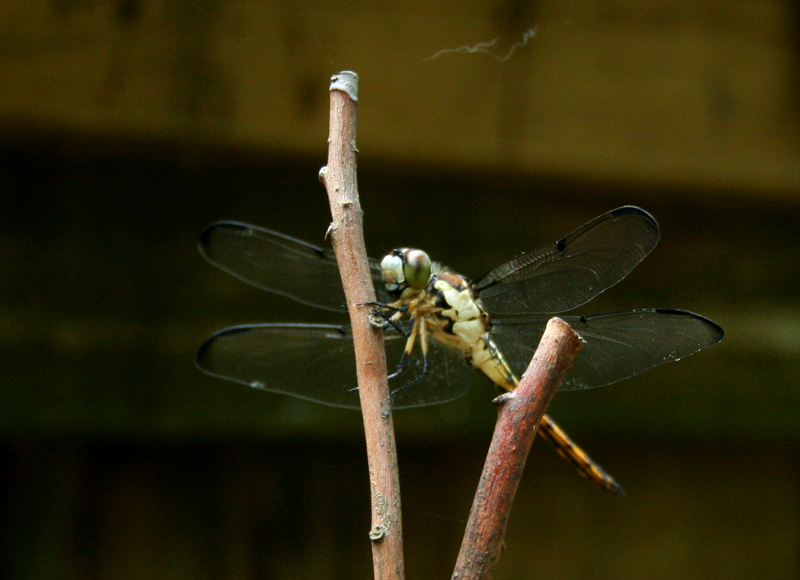
This dragonfly was napping on the same twig for hours. I was beginning to think he was dead, but then he suddenly flew away.

Saturday, May 08, 2010

A Shore Thing

So, what do Gulf Coast gardeners do when the heat kicks up in the garden? We get in our boats and ride.
In keeping with the gardening theme, I did see these brave little flowers growing in the sand on Santa Rosa Island. 
We walked across to the Gulf (of Mexico) to see that our beaches were still un-touched by the impending oil slick.
The beach was still clean and beautiful. There's much at stake here. We have some of the whitest sands in the world. (No kidding, I've been to beaches all over the world and I've never seen any as pretty as ours.)
They've set out numerous orange barriers in various areas of Santa Rosa Sound. It was great to see that even though the pass that feeds our sound will probably be protected, that they are taking no chances with the wildlife. 
We'd just jumped off the boat and were walking back home, when we spied this osprey high in a dead pine tree enjoying some sushi.

NOTE:  Last night we received our first whiff of the stench that folks in Louisiana are complaining about when the wind blew in from the direction of the oil spill. Yuck! 

Monday, May 03, 2010

Rain and Daisies

I've always loved wild daisies. They don't grow as rampantly down here as they do farther north. The weather has been foggy and overcast all weekend--not much for photography. I did pick some daisies and posed them in my kitchen window beneath my "bottle curtain". 
I did manage to catch a photo of this tiny bee working on one of my oxeye daisies.
We've had lots of rain this weekend. It's welcome, as is was becoming crunchy-dry around here, and even though we have a well-fed sprinkler system, there's nothing like rain to perk a garden up. 

This is my crazy season, though. This is the time of year I prefer to spend every available moment planting, weeding, and beautifying my garden. This is the time of year when I don't care what I look like, and most money I spend goes on plants. May is the month when I can finally assess the damage from the harsh winter. It looks like my pygmy date palms (roebelenii) did not make it. My bananas, however, are finally making an appearance. I still don't know if my caladiums are coming back. 

I keep hearing thunder, so I probably should post this...


PS--Here's a full picture of my bottle curtain:

Thursday, April 29, 2010

Some Creatures in My Garden

We have a tidal creek that winds through our property. When the tide is high, small fish like to swim around.
I have no idea what kind of fish they are, but they have these beautiful iridescent tails.
We have all kinds of snakes. This is a water snake, which apparently is not venomous. We have the "bad" snakes on our property too, but we leave them alone, and they leave us alone.
This tree frog is enjoying a little shelter from the sun.
A dragonfly is resting in my bamboo.

Monday, April 26, 2010

A Touch of Blue

So, what does a budding ceramicist do when her tiny house is beginning to overflow with pottery? She starts on the garden. Any bowl with a hole in the bottom becomes a flower pot.
This is also a sneaky way to ensure plenty of blue color in the garden. Above, the pot to the right with the bromeliad was originally designed to be a small birdbath, but the bottom split open in the kiln, so it will not hold water. (There are no mistakes in art, just changes in plans) A bowl becomes a flower pot when you poke a hole in the bottom.
Some of my pots were getting lost in my flower bed, and it was starting to look boring having everything at the same level. A large cobalt blue vodka bottle becomes an instant plant stand when you stuff it into the ground.
I got a little crazy and created a little butterfly bath (above). It has a little perch on the side and two little islands for them to perch on. It's filled with sand, which is kept wet. 
If you don't have a custom-designed butterfly bowl, you can always improvise with any bowl filled with sand. A couple of pebbles gives the butterflies something to perch on, but shells are more common down here. I had to use dirty sand from my garden to fill it, as I haven't been to the beach yet this season to collect some beautiful white sand.
I was going to join the bouquet theme mentioned here: April's MGB --Monthly Garden Bouquet  The day I decided to gather my flowers, however, nothing was cooperating. The flowers I picked wouldn't behave themselves in the bottle, and we had big storms moving in that made it so dark, I could only take a flash picture. (It looked terrible) I left the arrangement on the windowsill of my greenhouse with some blue bottles and forgot about it. Two days later, they were still looking perky and deserved to have their picture taken. The wine bottles were intended for a bottle tree, but for now they look so nice where they are.

What do you do when you have lots of bamboo and a rampant coral vine? You lash the bamboo together and build scaffolding around it. 
It's a little ugly now, but the vine will grow through it and over it in no time. In previous seasons, it grew too close to the house and would creep under the porch. This will give it more sun and give it more room to spread. I can make it as high as I like. I have a lot of bamboo on my property. 

Tuesday, April 20, 2010

How Does My Moss Garden Grow?

More and more people are becoming interested in growing moss gardens. I've been asked how I grew mine, so I will share.

I started my moss garden just last winter when I came to terms with the fact that there was one spot in my garden where no plants were ever happy. It's an area that drains poorly, and has rich silty soil that is packed down. Water pools in the area when it rains a lot. It's on the north side of my house and is shaded by a small live oak tree.

I prepared the area by adding some soil acidifier for good measure, and packing the soil back down. I collected the first pieces of moss from my parents' property, which has a large area of beautiful ferny looking moss. Their soil has lots of clay, whereas ours beneath the amended topsoil is pure sand. I collected large pieces in zip-lock bags, brought them home, and planted them immediately.
The picture above shows the fairly-new planted mosses, still looking a bit choppy. Below is a recent picture showing it having anchored itself down and filling in nicely. Note that the moss on the pots has receded somewhat. It's not that easy getting moss to survive on pots, but the surviving moss has attached itself to its surface.
The rule-of-thumb is that you should plant moss on a similar surface to where you find it growing naturally. So, moss found growing on wood, I planted on wood. Moss growing in dirt, I planted in dirt. I even found moss growing in sunny areas on sand, which I planted on the side of my little plot that gets afternoon sun.
Where did I find my mosses? Everywhere! I started taking walks around the neighborhood and found the most amazing mosses. I found mosses growing along drainage ditches, on the side of the road, I went into some woods and found some hiding under pine needles, and I found them growing on the banks of my own little creek. I strolled onto a piece of property that had been abandoned since our big hurricane, and found the most beautiful mosses--some a lush velvety green and some with star shapes that grew a few inches tall. I found mosses whose spores made them look so beautiful and delicate. Eventually, I ran out of room for them.
While the dominant moss is the ferny-looking moss, if you look closely, you can see the other types in between. I planted the pieces together like a living patchwork quilt.
On my daily walks, I carried a small spoon and a plastic bag. I don't know what people thought I was doing. Most people who walk with plastic bags pick up dog poop, but I don't have a dog. They'd see me bent over in abandoned lots, and straddling drainage ditches digging, things up and putting them into a plastic bag.
I kept my moss garden moist by making sure it was watered every day. We have a well for irrigation, so there was no worry of killing it with nasty chemical-laced city water. When the oak tree dropped its leaves, and the sun was beating down on my poor little mosses, I cut strips of window screening and laid them over the area. This allowed diffused light and water in, and also seemed to hold the moisture in a bit. I knew that once my tree filled in again, and the sun moved farther north that I could uncover them again. (See Moss Under Wraps)

I do sometimes have a problem of critters flipping over my mosses, so I have to check them often. Check out how Isadora has solved that dilemma in her moss garden:  Outwitting a Robin, Hawk Wars and Birds in Concert

Saturday, April 17, 2010

She-Bee, Moss Garden, and Strawberry Begonias

My she-bee is still hanging around the garden. She staggered out of a flower bed that I was watering. I'm guessing she didnt' like that. She wandered around my garden a bit and rested on a live oak leaf in my "lawn". (There's some sparse St. Augustine grass growing where we walk.) I don't really understand her behavior. I still haven't seen her fly. She was kind enough to pose for me for a while. Actually, I think she was taking a nap. I was worried someone might step on her.
I'm able to uncover my moss garden now that the live oak above it has re-grown its leaves again. It has filled in quite well. All my moss patches have anchored themselves down and spread. It's now this beautiful green carpet. Weeding it is interesting--definitely not for the impatient. It requires a zen-like attitude to pluck out tiny seedlings one at a time. Moss is so nice to touch, though, that it gives me an excuse to linger for a while.
All my strawberry begonias (Saxifraga) are blooming. I once read in a gardening book that strawberry begonias produce small insignificant flowers.
Insignificant?